
If you’re researching working at height qualifications, you may have come across the acronym ‘IPAF’, but what is IPAF training, who needs it and what does it involve?
International Powered Access Federation (IPAF) training is a range of internationally recognised training programmes for people who use, supervise or manage mobile elevating work platforms (MEWPs) and other powered access equipment.
Relevant to equipment including scissor lifts and boom lifts, IPAF training is delivered through a global network of IPAF-approved training centres.
Depending on the programme and the delegate’s responsibilities, training can cover safe operation, machine selection, inspections, working at height risks, management responsibilities and the correct use of personal fall protection equipment.
For operators, successful completion of the relevant IPAF training results in an IPAF Powered Access Licence (PAL Card), which records the categories of equipment for which the holder has successfully completed IPAF training and assessment.
What Is the International Powered Access Federation?
The International Powered Access Federation is a not-for-profit members’ organisation representing the powered access industry worldwide.
Established in 1983, its mission is to promote and enable the safe and effective use of powered access equipment.
Its membership includes manufacturers, rental companies, contractors, distributors, training providers and users of powered access equipment. In addition to its training programmes, IPAF produces technical guidance, safety campaigns, industry research and resources designed to improve the safe use of powered access.
IPAF also operates a network of approved training centres which are subject to its requirements and auditing processes. According to IPAF, its training programme for platform operators is certified by TÜV as conforming to ISO 18878, an international standard covering MEWP operator training.
This means that when an employer sends somebody on an IPAF course, the training follows an established IPAF programme rather than an individual provider developing its own interpretation of what an operator should know.
What Is IPAF Training Intended to Teach?
The exact syllabus depends on the IPAF programme being completed, but the overall purpose is to help people develop the knowledge and practical skills needed to work safely with powered access equipment.
For an operator, that means considerably more than learning which controls make a MEWP move up and down. Delegates need to understand the hazards associated with the equipment, how to inspect it before use, how to assess their working environment and how to operate it safely.
Depending on the course, training can cover:
- Identifying workplace and MEWP-related hazards.
- Carrying out pre-use inspections.
- Understanding emergency procedures.
- Applying safe operating techniques.
- Understanding risk assessments and safe systems of work.
- Selecting suitable MEWPs for particular tasks.
- Understanding responsibilities when working at height.
- Recognising situations in which a machine should not be used.
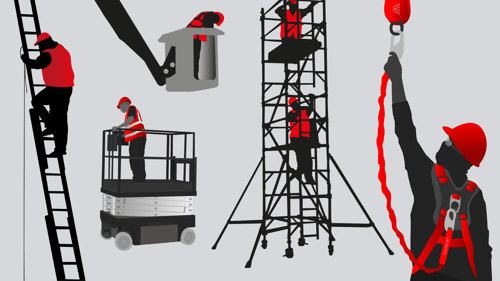
Proper planning, suitable equipment and competent people are therefore fundamental whenever work at height is being carried out.
For employers, appropriate IPAF training can form part of a wider system for ensuring that people who operate or manage MEWPs have received suitable instruction and training. However, completing an IPAF course doesn't remove an employer's responsibility to assess competence, provide appropriate supervision and ensure work is properly planned.
Based in Kent? Explore our Work at Height training courses
Who Is IPAF Training Designed For?
IPAF training isn't only intended for people whose job title specifically mentions powered access.
MEWPs are used across construction, facilities management, utilities, telecommunications, engineering, warehousing, maintenance, arboriculture and many other industries.
As a result, we train delegates from a broad range of roles, including construction workers, electricians, engineers, facilities and maintenance teams, telecommunications workers, arborists, local authority employees, site supervisors and health and safety managers.
The appropriate qualification depends on what that person actually needs to do. Someone operating a scissor lift, for example, will require different training from a manager responsible for planning and supervising MEWP operations.
Is IPAF Training Mandatory?
There is no blanket legal requirement in the UK stating that every MEWP operator must specifically hold an IPAF PAL Card.
What the law does require is that people involved in work at height are competent or, if they are being trained, are supervised by a competent person. Employers also have wider duties to ensure employees who use work equipment receive adequate training, including training in the methods that may be adopted when using that equipment and the risks its use may entail.
This distinction is important. IPAF itself isn't a legal requirement, and an IPAF PAL Card shouldn't be described as a statutory licence to operate a MEWP.
Instead, IPAF provides employers with an established and widely recognised system for training and assessing MEWP operators.
Individual employers, contractors or sites may also specify an appropriate IPAF qualification as a contractual or site requirement before somebody is permitted to operate particular equipment.
Likewise, completing an IPAF course doesn't transfer responsibility away from the employer, who still needs to ensure the equipment is suitable, risks have been assessed, the work is properly planned and supervised, and the operator is competent to carry out the work safely.
Which IPAF Course Do I Need?
There isn't one single qualification called an ‘IPAF licence’.
IPAF provides different training programmes and machine categories depending on the equipment being used and the delegate's responsibilities.
For MEWP operators, two of the categories people most frequently encounter are 3A and 3B. IPAF defines 3A as mobile vertical machines and 3B as mobile boom machines. In practical terms, 3A commonly includes equipment such as scissor lifts, while 3B includes boom-type MEWPs.
Delegates who need to operate both categories can complete training covering both 3A and 3B.
|
IPAF Training |
Suited To |
General Focus |
|
IPAF Operator 3A |
Operators of mobile vertical MEWPs, including scissor lifts |
Safe inspection and operation of 3A machines |
|
IPAF Operator 3B |
Operators of mobile boom MEWPs |
Safe inspection and operation of 3B machines |
|
IPAF Operator 3A & 3B |
Operators who need to use both categories |
Training and assessment across both MEWP categories |
|
IPAF MEWPs for Managers |
People who plan, supervise or manage MEWP operations |
Planning, selection, supervision and management of MEWP use |
|
IPAF Harness Training |
People who use personal fall protection equipment in MEWPs |
Selecting, checking and using harnesses and lanyards appropriately |
|
IPAF Harness Inspector |
People responsible for inspecting harnesses and lanyards |
Detailed inspection and record keeping |
|
IPAF PDI |
People responsible for preparing MEWPs before delivery or use |
Pre-delivery inspection procedures |
You can view a full range of IPAF courses in Kent here.
The right course should therefore be determined by the employee's responsibilities and the equipment they will actually use, rather than simply choosing whichever IPAF qualification is most common.
An employer whose staff use several forms of access equipment may also need to consider additional training. IPAF training for a MEWP, for example, doesn't demonstrate that somebody has been trained to assemble a mobile access tower or use ladders safely.
What Happens During an IPAF Course?
The structure depends on the programme, but IPAF operator training incorporates both theory and practical learning. This gives delegates an opportunity to understand the principles behind safe MEWP operation before demonstrating that they can apply them to the equipment itself.
During operator training, delegates can expect to cover subjects including MEWP categories, structural components, regulations and guidance, pre-use inspections, safe operating methods and workplace hazards. They then undertake practical instruction and assessment using the relevant machine category.
Assessment is an important part of the process because completing IPAF training isn't simply a matter of attending the course. Delegates need to demonstrate the required knowledge and practical ability. For somebody completing 3A and 3B training, for example, that means successfully completing the required training and assessment for both mobile vertical and mobile boom categories.
The exact course duration, syllabus and practical requirements depend on the programme being completed and the number of machine categories involved.
Related reading: How much does an IPAF course cost?
What Is an IPAF PAL Card?
Successful delegates on qualifying IPAF programmes receive a Powered Access Licence (PAL Card). The PAL Card provides evidence that the holder has successfully completed the relevant IPAF training and assessment and records the categories they have completed.
This makes it easier for employers, contractors and site managers to check which IPAF categories an individual holds. However, a PAL Card shouldn't be treated as proof that somebody is automatically competent to carry out every MEWP task in every environment.
Competence also depends on factors such as experience, familiarity with the equipment being used, the nature of the task and the conditions in which the work is taking place. PAL Cards can also be accessed digitally using IPAF's ePAL app, allowing operators to access and share their qualifications using a smartphone. IPAF also provides a PAL Card verification service that employers and others can use to check card details.
How Long Does an IPAF Licence Last?
An IPAF PAL Card is generally valid for five years, with the expiry date displayed on the card and through ePAL.
Operators and employers should keep track of expiry dates, particularly where an in-date IPAF qualification is required by a client, contractor or site. Operators approaching the end of their PAL Card's validity should check the current renewal options and eligibility requirements published by IPAF or speak to an approved training centre about the appropriate route.
It is equally important to remember that an in-date PAL Card is only one part of managing competence. An operator may still require familiarisation before using a MEWP they haven't operated before, particularly where controls, features or characteristics differ from machines with which they are familiar.
Employers should therefore consider training, experience, familiarisation, supervision and the demands of the particular task rather than treating the expiry date on a card as the sole measure of whether somebody can work safely.
IPAF vs Other Work at Height Qualifications
IPAF is specifically associated with powered access equipment, which means it shouldn't be treated as a universal qualification covering every form of work at height.
Different access methods require different knowledge and practical skills. Someone who holds an IPAF qualification for operating a scissor lift isn't automatically trained to assemble a mobile access tower, just as somebody trained to use a tower isn't automatically trained to operate a boom lift.
|
Training or Qualification |
Primarily Covers |
|
IPAF |
Mobile elevating work platforms and powered access equipment |
|
PASMA |
Mobile access towers and related tower configurations |
|
Ladder Association |
Safe use of ladders and stepladders |
|
Safety Harness Training |
Selection, inspection and/or use of personal fall protection equipment |
Some employees will consequently require several types of work at height training. A maintenance engineer might use a MEWP for one task, a mobile access tower for another and a ladder for shorter-duration work, for example.
Training should therefore reflect the equipment employees actually use and the risks they encounter rather than relying on a single qualification to cover every situation.
Why Is Accredited IPAF Training Important?
The Work at Height Regulations require employers to ensure that work at height is properly planned, appropriately supervised and carried out by people who are competent to do it. Other health and safety legislation places additional duties on employers regarding the provision and use of work equipment and employee training.
Choosing an IPAF-approved training centre provides a recognised route for delivering MEWP training and assessment through IPAF's established programmes.
For employers, a PAL Card can provide useful evidence that an individual has successfully completed specified IPAF training and assessment. It should, however, form part of the employer's wider arrangements for managing competence rather than replacing them.
This means considering whether an operator has sufficient experience, whether they are familiar with the particular machine, whether additional instruction is necessary and whether they can apply their knowledge safely to the task and environment in front of them.
Kentec Training IPAF Instructor Marc Torrance explains:
“Powered access equipment can make many jobs and tasks safer to complete than using traditional access methods, but this only applies when it is used correctly. IPAF training gives delegates the practical skills they need to operate equipment, but just as importantly, it develops the judgement needed to recognise hazards, make appropriate decisions and understand when equipment shouldn't be used. That combination of knowledge and practical ability is what contributes to safer work at height.”
Why Choose Kentec Training for IPAF Training?
The quality of IPAF training isn't only determined by the course syllabus. The experience of the instructor, the equipment delegates train on and the environment in which practical training takes place can all make a significant difference to the learning experience.
At Kentec Training, we have invested heavily in creating dedicated facilities specifically for practical work at height training, supported by expert instructors with more than 20 years of industry and training experience. We also have dedicated training MEWPs, giving delegates the opportunity to develop their practical skills using equipment specifically available for training and assessment.
Our Ashford Training Centre sets us apart even further. Kentec Training is home to the UK's only indoor IPAF training centre with an 11-metre-high ceiling, providing an exceptional purpose-built environment for practical MEWP training.
The scale of the facility means delegates can complete practical IPAF training indoors throughout the year, without courses being dictated by rain, wind, cold temperatures or other changing outdoor conditions. Instead, delegates can train in a controlled and comfortable environment with the space required to properly operate and manoeuvre MEWPs.
This can be particularly valuable for new operators. Learning to use a MEWP involves taking in a considerable amount of information, from pre-use inspections and controls to positioning, hazards and emergency procedures. Training indoors provides a consistent environment in which delegates can concentrate on developing those skills while our instructors introduce the scenarios, hazards and practical exercises required by the course.
More experienced operators also benefit from being able to focus their time on the equipment, practical exercises and assessment without unnecessary disruption from poor weather.
Our IPAF training is supported by:
- Expert instructors with 20+ years of experience, combining extensive industry knowledge with practical training expertise.
- Dedicated training MEWPs, ensuring delegates have suitable equipment available for practical training and assessment.
- The UK's only indoor IPAF training centre with an 11-metre-high ceiling, located at our purpose-built Ashford Training Centre.
- All-weather, year-round practical training, providing a reliable and consistent training environment whatever the conditions outside.
- Climate-controlled classrooms alongside our extensive indoor practical facilities, creating a comfortable environment for both theory and practical training.
- Extensive experience delivering accredited work at height training across IPAF, PASMA and the Ladder Association, alongside our specialist safety harness training.
Together, our instructors, equipment and facilities make Kentec Training a premier choice for IPAF training in Kent and the South East. Delegates aren't simply attending a course to obtain a PAL Card; they're learning in an environment purpose-built to help them develop the knowledge, practical ability and confidence to use powered access equipment safely.
What Does IPAF Training Mean for Employers and Operators?
IPAF training provides a structured and internationally recognised way for people to develop and demonstrate knowledge and practical ability when working with powered access equipment.
For operators, that means learning how to inspect and use relevant MEWPs safely, recognise hazards and demonstrate their ability through theory and practical assessment. For managers and supervisors, separate IPAF programmes can provide knowledge relevant to planning, managing and overseeing MEWP operations.
The key distinction is that IPAF training itself isn't mandatory under UK law and a PAL Card isn't a statutory licence to operate a MEWP. Instead, IPAF provides a recognised training and assessment system that employers can use as part of fulfilling their wider responsibilities for training and competence.
Those responsibilities continue after the course has finished. Employers still need to consider risk assessment, equipment selection.
For more information about IPAF courses and to find out which are relevant for your specific situation, get in touch with Kentec today.